
- GenAI Literacy & Tools
- Framework for Evaluating Sources
- Citing AI Generated Materials
- Use of AI in Scholarly Publishing
- GenAI Copyright
- Hot Topics

GenAI spans a broad spectrum. While LLMs (like ChatGPT) and Diffusion Models are the most prominent, GenAI includes diverse technologies. Model selection depends on data type (text/image/audio), output quality, and efficiency needs.
Introduced by the Teaching and Learning Development Office (TLDO), HKSYU staff and students can:
- Use HKSYU ChatGPT to facilitate teaching, learning, and assessment tasks.
- View HKSYU ChatGPT Tutorials to learn more about HKSYU ChatGPT and the University's guidelines.
- Understand the Guidelines on the Use of Generative AI in Teaching, Learning, and Assessment (English Version | Chinese Version) to make appropriate adaptations to incorporate the use of AI in assignments.
Language learning resources on AI developed by the HKSYU Language Centre:
| Discover@Shue Yan Research Assistant |
|---|
| It enables you to search through academic materials using natural language queries. It scans the majority of the Library's content to recommend five relevant documents that address your question. (▶️workshop recording) |
| Consensus |
|---|
| It is an AI-powered search engine that helps you find evidence-based answers in scientific research. It extracts key insights from peer-reviewed studies and summarizes them in clear, concise takeaways. (▶️workshop recording | Consensus Guide) |
| Scite |
|---|
| It is an AI-powered research tool that helps you evaluate scientific papers by showing how they've been cited in later publications. It highlights whether citations support, contrast, or merely mention the original work, providing context for credibility. (▶️workshop recording) |
| Statista Research AI |
|---|
| Statista Research AI is an artificial intelligence-powered tool that provides data-driven insights and statistics across industries. It helps users quickly access reliable market research, trends, and forecasts to support decision-making. |
| CNKI AI |
|---|
| It is an AI-powered research tool that helps you evaluate scientific papers by showing how they've been cited in later publications. It highlights whether citations support, contrast, or merely mention the original work, providing context for credibility. |
The CRAAP test is a useful framework for evaluating the reliability and credibility of sources used in research.
Credible sources are essential in ensuring the accuracy of information, strengthening arguments, and reinforcing conclusions. With the vast amount of available information, distinguishing trustworthy sources requires careful scrutiny—a vital skill in information literacy.
To assist researchers in this effort, librarians at California State University introduced the CRAAP Test in 2004. This method provides a structured approach to assessing a source’s Currency, Relevance, Authority, Accuracy, and Purpose, helping individuals make informed decisions about the credibility of information. It can also be applied by end-users to evaluate sources generated by AI.
Using the CRAAP test to evaluate AI-generated content ensures that the information you rely on is trustworthy, relevant, and accurate. It’s always a good practice to cross-check AI-generated responses with authoritative sources before using them for research or decision-making.
Always follow your instructor's or publisher's citation guidelines.
Additionally, verify AI-generated facts, as they may be inaccurate due to hallucinations.
If you want to know more about examples of citation formats for generative AI, you can also refer to Appendix C: Citation Formats of Generative AI in APA and MLA, in the Hong Kong Shue Yan University Guidelines on the Use of Generative AI in Teaching, Learning, and Assessment by the TLDO.
APA Style
The American Psychological Association (APA) recommends treating AI-generated content similarly to citing software or an algorithm, as discussed in the blog post "How to Cite ChatGPT". The key is to credit the creator of the AI model.In-Text Citation:
- Parenthetical: (Creator, Year of the Version)
- Example: (OpenAI, 2023)
- Narrative: Creator (Year of the Version)
- Example: OpenAI (2023) stated that...
- Format: Creator. (Year of the Version). Name of AI Model (Version, if applicable) [Description of model, e.g., Large language model]. URL
- Example: OpenAI. (2023). ChatGPT (Mar 14 version) [Large language model]. https://chat.openai.com/chat
- Non-retrievable Text: Since the exact output from an AI chat is often not retrievable by others, APA likens it to sharing an algorithm's output rather than personal communication.
- Version Information: Include the version of the AI model if available, as this helps with reproducibility and acknowledging updates. For ChatGPT, the version often includes the date.
- In-Text Description: It is helpful to briefly mention in your text how you used the AI tool.
- Appendices: For lengthy AI-generated text, consider including it in an appendix.
- AI-Generated Images: For images you create with AI, provide a figure number, a brief title, and a note below the image crediting the AI tool and including the prompt used. A reference list entry is generally not needed for images you personally generated. If you use an AI-generated image from another source, cite the source.
Chicago Style
The Chicago Manual of Style offers guidance for both the Notes and Bibliography and Author-Date systems. The general principle is can also applied to the use of AI.Notes and Bibliography System:
- Footnote/Endnote:
- Number. Text generated by Name of AI Model, Developer, Date generated, URL (if publicly available).
- Example: 1. Text generated by ChatGPT-4, OpenAI, September 30, 2024, https://chatgpt.com/share/xxxxxxxxxxxxxxxxxxxxxxxxx.
- If the prompt is relevant and not in the text:
- Number. Name of AI Model, response to "Your prompt," Developer, Date generated, URL (if publicly available).
- Example: 2. ChatGPT-4, response to "Tell me how to fix a flat bicycle tire," OpenAI, September 30, 2024, https://chatgpt.com/share/xxxxxxxxxxxxxxxxxxxxxxxxx.
- Bibliography Entry: Chicago generally advises against including AI-generated text in the bibliography if the output is not publicly accessible via a stable URL. If you do include it (e.g., if a shareable link is available), treat it like personal communication but cite the developer as the "author".
- Developer. Response to "Your prompt." Name of AI Model, Version (if applicable), Date generated, URL.
- Example: OpenAI. Response to "Tell me how to fix a flat bicycle tire." ChatGPT-4, September 30, 2024, https://chatgpt.com/share/xxxxxxxxxxxxxxxxxxxxxxxxx.
- In-Text Citation: (Developer, Year) or (Name of AI Model, Year) if the developer is also closely associated with the model name.
- Example: (OpenAI, 2024) or (ChatGPT, 2024)
- Reference List Entry: Similar to the Bibliography entry in the Notes and Bibliography system, include an entry only if a stable, public URL is available.
- Developer. Year. Response to "Your prompt." Name of AI Model, Version (if applicable), Date generated. URL.
- Example: OpenAI. 2024. Response to "Summarize the main arguments of the book." Gemini, April 21. https://gemini.google.com/share/xxxxxxxxxxxxxxx
- Acknowledge in Text: Regardless of the citation style, Chicago emphasizes the importance of acknowledging the use of AI in your text, preface, or a note. Explain how you used the AI.
- No Authorship: AI is not considered an author. Credit the developer or the AI model itself.
- Verifying Information: Always critically evaluate and verify any information provided by AI with reliable sources.
- AI-Generated Images: Credit the source of AI-generated images in captions. If you generated the image, include the prompt, the AI tool used, and the date. A bibliography entry is usually not required unless a stable URL is available.
A Chinese version is also provided, especially for academic papers written in Chinese. When using foreign language literature and providing annotations for it, they should adopt the Chicago Manual of Style, Notes-Bibliography System. This format suggests citing ChatGPT in footnotes as personal communication, similar to unpublished interviews. Because ChatGPT records cannot be reviewed by third parties via a URL, they should not be included in the bibliography. If the prompts the author used on ChatGPT are mentioned in the main text, the footnote should include "Text generated by ChatGPT" (「文本由ChatGPT生成」), the date of the query (「提問日期」), "OpenAI" (「Open AI」), and the general URL for the tool, rather than a specific URL for the response, as that link will not be valid for other users.
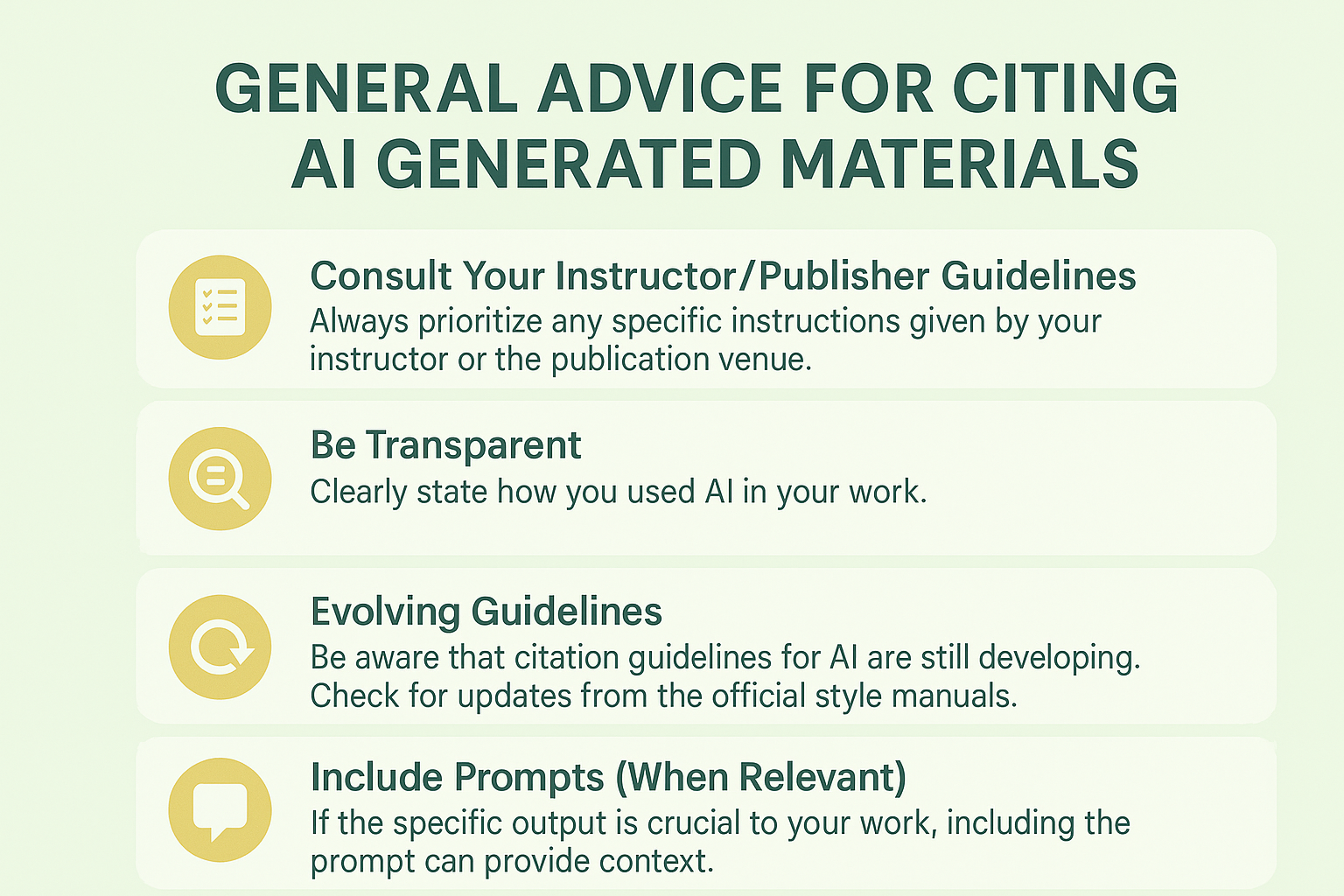
Created by HKSYU Library, generated using ChatGPT on 22 April 2025.
This infographic is licensed under a Creative Commons Attribution 4.0 International License (CC BY 4.0).
Generative AI Policies for Journals
Elsevier has outlined clear policies on the use of generative AI and AI-assisted technologies in scientific writing and publishing. Key policies include:
- AI tools can only be used to improve readability and language but not to replace key authoring tasks like generating scientific insights or conclusions.
- Authors must disclose their use of AI tools in their manuscripts, and a statement will appear in the published work to ensure transparency.
- AI tools cannot be credited as authors or co-authors, as authorship requires accountability and responsibilities that only humans can fulfill.
- AI-generated or AI-altered images are not permitted in submitted manuscripts, except when AI is part of the research design or methods.
- This guidance clarifies the responsibilities of reviewers and authors, with a detailed FAQ provided for reference.
Emerald Publishing’s Stance on AI Tools and Authorship
Emerald Publishing acknowledges the growing role of AI in research but emphasizes transparency, accountability, and ethical use. Key announcements include:
-
AI tools cannot be credited as authors since they lack accountability for the work generated.
-
Authors must disclose their usage of AI tools during submission.
-
AI tools can assist in copy-editing to improve language and readability.
-
AI tools are prohibited from creating original content or being involved in the peer review process.
-
AI-generated images are not accepted for publication.
-
Emerald Publishing emphasizes transparency, integrity, and high-quality academic content while adapting policies as AI technology evolves.
Author Use of Artificial Intelligence (AI)
Oxford University Press (OUP) has issued a policy on AI use in academic book publishing, outlining guidelines for authors.
These guidelines may evolve as AI technology advances, so authors should check for updates during submission.
- AI cannot be listed as an author or perform core writing tasks like generating arguments or conclusions. Any AI-generated content requires OUP's prior written permission and may need replacement with human-created content.
- Authors are fully responsible for all content accuracy, originality, and ethics - including AI-assisted portions - and must verify proper attribution while avoiding bias or conflicts.
- All AI use in content creation must be disclosed to the Acquisitions Editor and properly cited according to style guidelines.
- Scholars advising OUP must submit only vetted, expert-approved material and balance AI-generated ideas with their professional judgment.
- Manuscripts or project materials must never be uploaded to generative AI tools to protect intellectual property.
Sage's Guidelines on AI in Peer Review and Publishing
Authors must disclose any use of AI tools that generate content (such as text, images, or references). Original sources should always be cited instead of AI tools as primary references. AI-assisted or AI-generated submissions must be disclosed at the time of submission for editorial evaluation. Authors are required to adhere to Sage guidelines, specifically to:
- Authors must clearly state in the methods or acknowledgments section which language model was used and its specific purpose in the research.
- All AI-generated content and citations must be carefully checked for accuracy, validity, and appropriateness, with any errors or biases corrected.
- Authors should verify that the AI hasn't plagiarized by checking original sources for any reproduced text.
- Every factual claim and citation must be confirmed as authentic, as AI may generate false information or nonexistent sources.
- AI tools like ChatGPT cannot be listed as authors on any submission.
- Authors maintain full responsibility for all aspects of their manuscript, including any AI-assisted content.
Taylor & Francis AI Policy
Authors are fully accountable for ensuring the originality, validity, and integrity of their submissions. All content must meet rigorous scholarly standards and represent the author's own intellectual work, with proper validation of research and analysis.
Taylor & Francis supports responsible use of generative AI tools for specific applications, provided they adhere to strict standards of data security, confidentiality and copyright protection. Approved uses include:
- idea generation and exploration
- language improvement
- enhanced literature searches using LLM-powered tools
- research classification
- coding assistance
All AI-generated content must be carefully reviewed for accuracy. Journal authors must follow editorial policies and publishing ethics, while book authors must comply with specific publishing guidelines. Importantly, AI tools cannot be listed as authors under any circumstances.
Any use of generative AI assistance must be explicitly acknowledged within the manuscript or book. Authors must transparently disclose how AI tools were employed in their research or writing process.
Artificial Intelligence General Guidance & Best Practice
Wiley allows AI in manuscripts if authors:
- uphold standards
- protect rights
- disclose use
Full accountability remains with authors.
Any use of GenAI tools in manuscript development must be fully disclosed in either the Methods section, a dedicated disclosure statement, or Acknowledgements, with specific details about how the tool was used.
Authors bear complete responsibility for verifying the accuracy of all AI-generated content and must properly cite any sources the AI tool references.
GenAI tools are strictly prohibited from being used to create, alter, or manipulate original research data and results.
Basic editing tools for spelling, grammar, and general language improvements are exempt from these disclosure requirements.
Journal editors retain final authority to determine whether any GenAI use in a submission or published article complies with the publication's editorial policies.
In peer review contexts, GenAI tools may only be used minimally and with appropriate safeguards to maintain review integrity.
Nine Categories of Copyright Works (版權作品)
In Hong Kong, copyright law is defined by the Copyright Ordinance (Cap. 528), which extends protection to only these nine specified classes of works.
| *Original Works | ||
|---|---|---|
Collectively referred to as "Literary and Artistic Works (文藝作品)" * "Literary and Artistic Works (文藝作品)" must meet the originality requirements |
| Other Copyright Works | ||
|---|---|---|
Collectively referred to as "non-literary works (非文藝作品)" |
Relevant Provisions Under Current Copyright Legislation:
Original literary, dramatic, musical and artistic works (Literary and Artistic Works)
- Created by human authors
- Computer-generated (i.e., without human authorship)
- Author (First Copyright Owner): The person making the arrangements necessary for the work's creation
- Copyright Duration
- May extend to AI-generated original Literary and Artistic Works
"Copyright in a work is infringed by a person who without the licence of the copyright owner does, or authorizes another to do, any of the acts restricted by the copyright". (「除非有關行為屬法定允許作為,否則任何人未獲作品的版權擁有人的特許,而自行或授權他人作出任何受版權所限制的作為,即屬侵犯作品的版權。」)
- Exercise caution when using content that may involve others' copyrighted works.
- Prioritize original creations whenever possible.
- Comply with the terms of service/use of the AI system or website.
- Verify whether the AI developer has obtained proper licensing from copyright owners to use protected works for training their generative tools.
- Understand Creative Commons(CC) Licenses and Generative AI. Utilize CC works and adhere strictly to their licensing terms.
- Sources for AI-Generated Works under CC Licenses
- Wikimedia Commons – A free media repository that allows users to share and access a vast collection of images, audio, and video files under open licenses (e.g., CC License, GNU Free Documentation License, Artistic License, and Free Art License) or in the public domain.
- Search "AI-generated Creative Commons" on Wikimedia Commons.
- Openverse – A search engine designed to help users discover free stock photos, images, and audio available under Creative Commons licenses or in the public domain.
- Search for a keyword and use filters to sort by CC license type.
- DeviantArt – An online art community where artists share and sell diverse creative works, including digital art, photography, and AI-generated content, under various licenses (though Creative Commons options are limited).
- Search for AI art, then verify CC licenses individually in the "Details" tab.
- Stable Diffusion Gallery – A collection of AI-generated images created using the Stable Diffusion model, where users can explore, share, and sometimes download artworks.
- Be primarily licensed under CreativeML OpenRAIL++. Some AI-generated works may be released under CC licenses, depending on the creator or platform. For example, projects like CommonCanvas train diffusion models using images licensed under Creative Commons.
- MidJourney Gallery – A collection of AI-generated images created through text prompts, the MidJourney Gallery showcases diverse artworks from its community, though most content retains full copyright protection unless individually marked with Creative Commons licenses by creators.
- Search MidJourney's gallery manually for license declarations in descriptions (despite lacking official CC tagging tools), as some creators may self-report alternative licenses while most default to copyright.
- OpenGameArt – A free and open-source media repository that provides game developers with assets, including sprites, textures, sound effects, and music, all available under permissive licenses for creative projects.
- Search for AI-generated assets using CC license filters.
- Wikimedia Commons – A free media repository that allows users to share and access a vast collection of images, audio, and video files under open licenses (e.g., CC License, GNU Free Documentation License, Artistic License, and Free Art License) or in the public domain.
- Sources for AI-Generated Works under CC Licenses
- Key Considerations
- ✔ Verify the License – CC0 = public domain (no attribution), CC BY = requires credit, CC BY-NC = non-commercial use.
- ✔ Check Platform Rules – Some sites ban AI-generated content, while others embrace CC licensing.
- ✔ Ethical Use – Ensure the AI tool’s terms allow CC licensing (e.g., Stable Diffusion permits CC0; DALL·E 3 has restrictions).